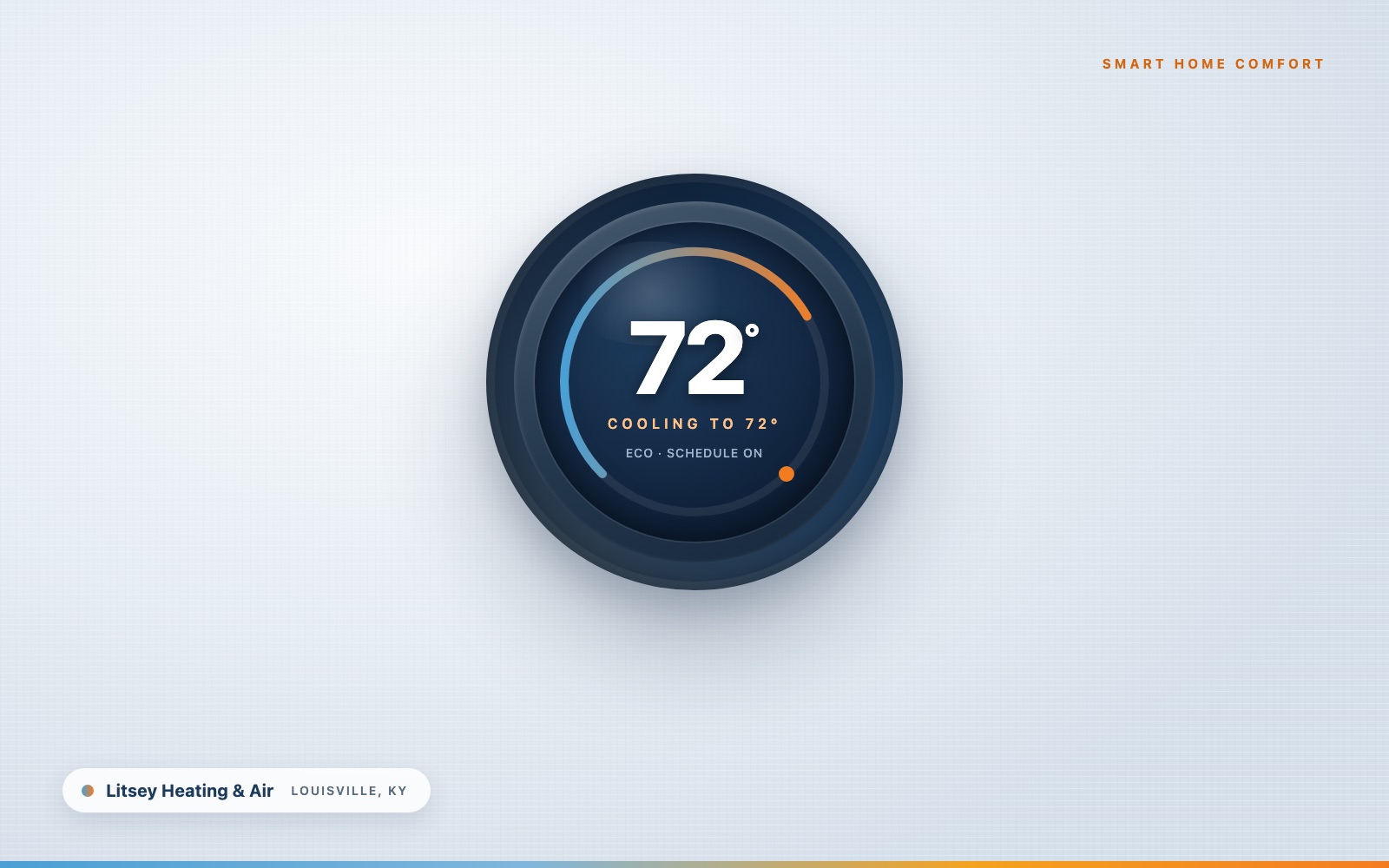
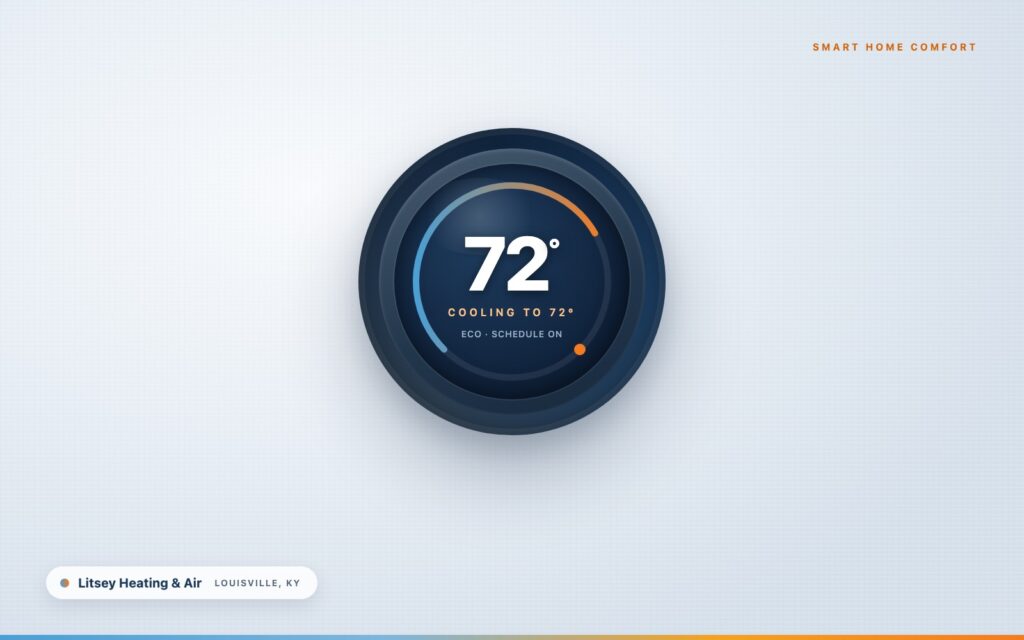
The thermostat is where every heating problem shows up first — a blank screen, a “Heat On” message with no warm air behind it, a house that never reaches the number on the wall. That makes it the most-blamed part in the system, and about half the time it’s innocent: the thermostat is a 24-volt switch that gets its power from the furnace, so a furnace problem looks exactly like a thermostat problem from the hallway. Here are the ten causes we actually find on Louisville service calls, in the order you should check them, and the point at which it stops being a thermostat question and becomes a furnace one.
First: which symptom do you have?
- Blank screen, no lights. Dead batteries, no power reaching the thermostat, a blown fuse on the furnace board, or a safety switch open. Start at fixes 1, 3, 4, 5 and 6.
- Screen works, says Heat / Heat On, but the furnace never starts. Setpoint or mode, a wiring fault, or the furnace itself. Fixes 2, 7 and the furnace section.
- Furnace runs, but the house never reaches the set temperature, or the reading is wrong. Placement, calibration, a drafty wall hole, or an airflow problem that isn’t the thermostat at all. Fixes 8 and 9.
- Furnace won’t shut off. Fan set to On, a stuck relay, or a thermostat wired or configured for the wrong system. Fix 2, then call.
- Smart thermostat offline, rebooting, or “low battery” with no batteries. Fix 10 — almost always the C-wire.
The 10 fixes, easiest first
1. Replace the batteries
Most battery thermostats take two AA or AAA cells and go dim long before they die outright. Replace them even if the screen is still on, close the cover, and give it a full minute. Many models show a small battery icon weeks before the display quits — that icon is the thermostat asking politely.
2. Check the mode, the setpoint, the fan and the schedule
Set the mode to Heat (not Cool, Off, or Auto on some models), the temperature at least three to five degrees above the current room reading, and the fan to Auto. If the fan is on On, the blower runs constantly and pushes cool air between heating cycles, which feels like “the heat isn’t working.” Look for a schedule or a Hold that’s overriding what you just set, and for a “wait” or “delay” message: heat pumps and many furnaces enforce a five-minute restart delay after any change, and that’s normal.
3. Check the breaker and the furnace’s own power switch
Hardwired thermostats are powered by a small transformer inside the furnace. No power to the furnace means a blank thermostat. Check the breaker labeled Furnace or HVAC in the panel (flip it fully off, then on), then find the light-switch-style power switch on or beside the furnace — someone flips it off surprisingly often, especially around a water heater or in a utility closet that doubles as storage.
4. Push the furnace door closed
The lower blower door presses a safety switch. If the door was taken off to change the filter and not seated firmly, that switch stays open, the furnace has no power, and the thermostat goes dark. Press the door in until it clicks or seats flush.
5. A tripped safety switch in the condensate line
High-efficiency furnaces and the air-conditioner coil above most furnaces drain water through a small line. If it clogs, a float switch opens the thermostat circuit so the system can’t flood the floor. The screen may stay on, but nothing runs — or the display goes blank on some setups. Look for water in or under the drain pan or a small switch with a float on the drain line. Clearing the line restores everything; it’s also one of the items in our fall tune-up checklist.
6. The blown fuse on the furnace control board
Nearly every furnace made since the 1990s has a small 3-amp automotive-style fuse on its control board protecting the 24-volt circuit. It blows when two thermostat wires touch — most often during a DIY thermostat swap — or when a wire chafes through in the wall. A blown fuse means a blank thermostat with the furnace otherwise powered. Replacing it is simple if you’re comfortable with the panel off; if the new fuse blows too, stop, because the short is still there and that’s a service call.
7. Loose or corroded wiring
Thermostat wire is thin, and connections loosen at the thermostat base and at the furnace board. Pull the thermostat off its base and check that each wire is seated and labeled (R or Rc, W, Y, G, C). A wire that’s fallen out of W means the heat never gets the call; a loose R means no power at all. If the wires are green or crusty, that corrosion is the problem.
8. Where the thermostat lives
A thermostat on an exterior wall, in direct afternoon sun, next to a supply register, above a lamp or a TV, or beside the kitchen reads the wrong temperature and heats the house for the wrong reasons. The hidden one: the hole in the wall behind the base where the wires come through. In older Louisville homes that hole lets cold air from inside the wall wash over the sensor, so the thermostat thinks the room is colder than it is and overheats the rest of the house. Stuff the hole with a bit of insulation or putty. If the reading is off by a few degrees everywhere, most digital thermostats have a calibration offset in the settings menu. And if some rooms are fine and one never warms up, that’s airflow, not the thermostat — see why one room is always cold.
9. The thermostat is simply worn out
Old round mechanical thermostats with a mercury switch drift out of level and out of calibration; cheap digital ones lose their relays after ten or fifteen years and start sticking on or off. If yours is older than the furnace, has a sluggish or faded display, or clicks without the furnace responding, replacing it costs less than diagnosing it. Our guide to smart thermostats covers what a modern one gives you.
10. Smart thermostat problems: the C-wire
Nest, ecobee, Honeywell Home and the rest need constant 24-volt power. Without a dedicated common (C) wire they “steal” power through the heating circuit, which works on some furnaces and on others causes random reboots, Wi-Fi dropouts, “low battery” warnings, a furnace that clicks on and off for a second at a time, or a blower that runs when it shouldn’t. If any of that started when the smart thermostat was installed, the fix is a proper C-wire — run from the furnace board, or added with the manufacturer’s power adapter. Also check the app: a schedule, Eco or Away mode, or a geofence that thinks nobody’s home will hold the temperature down and look like a fault.
When it’s the furnace, not the thermostat
If the screen is on, the mode and setpoint are right, and you hear the thermostat click but the furnace does nothing — or it starts and quits within seconds — the thermostat has done its job and the problem is downstream. The usual suspects are the ones in our guides to a furnace that isn’t heating (ignition lockouts, a dirty flame sensor, a tripped limit) and furnace short cycling. A technician confirms it in one step: a jumper from R to W at the furnace board. If the furnace fires, the thermostat or its wiring is at fault; if it doesn’t, the furnace is. That’s a quick check with the panel off and the power on, so unless you’re comfortable with both, leave it to us.
Should you repair or replace the thermostat?
Thermostats last roughly ten years. If yours is a basic digital or mechanical unit and the problem is anything other than batteries, replacement usually makes more sense than repair, and it’s a good moment to decide whether a programmable or smart thermostat is worth it for your house (setbacks are one of the ten fixes for a high heating bill). Two cautions: match the thermostat to the system — a heat pump with auxiliary heat, a two-stage furnace, or a dual-fuel setup each need specific wiring and settings, and the wrong configuration runs the expensive backup heat all winter — and have a C-wire run if the new thermostat needs one. We install thermostats as a standalone visit or during a maintenance plan tune-up, and we check the furnace end of the wiring while we’re there.
What a thermostat service call includes
We confirm 24 volts at the board and the thermostat, test each wire and the fuse, check every safety switch in the circuit, verify the thermostat’s system configuration (furnace, heat pump, stages), calibrate the reading and fix the wall opening behind it. If the thermostat needs replacing, we fit the one you choose, set the schedule with you and make sure the app is connected before we leave. You get a written quote before any part is replaced; Annual Service Plan members get 10% off parts.
Thermostat FAQs
Why is my thermostat screen blank?
Dead batteries first. If it’s hardwired, the furnace isn’t sending it 24 volts: breaker, the furnace power switch, the blower door switch, a float switch on the condensate line, or the 3-amp fuse on the control board. Work through fixes 1, 3, 4, 5 and 6 in that order.
My thermostat says “Heat On” but there’s no heat. Why?
The thermostat is calling; the furnace isn’t answering. Check the furnace’s power switch and door, then look through the sight glass on the furnace for a flashing error code. It’s usually ignition, the flame sensor or a limit switch — our 8 quick furnace checks walk through it.
Why does my hardwired smart thermostat complain about low battery?
It’s running on stolen power because there’s no C-wire, and its internal battery can’t keep up. A C-wire (or the maker’s power adapter) ends the warnings, the reboots and the Wi-Fi drops.
Can I replace a thermostat myself?
Like-for-like swaps are a reasonable DIY job if you photograph the wiring first and turn the furnace off at the switch so you don’t blow the board fuse. A heat pump, a two-stage furnace, dual fuel, or any system where you’re not sure what each wire does is worth a professional hour — the wrong configuration is the expensive kind of mistake.
Why doesn’t my house reach the temperature I set?
If the furnace runs and runs without catching up, the thermostat is doing its job and the house or the furnace is the issue: a dirty filter, duct leaks, a furnace that’s lost capacity, or a very cold snap pushing an undersized or aging system. See uneven heating and how long a furnace lasts.
How much does it cost to fix or replace a thermostat in Louisville?
A fuse, a loose wire or a calibration is at the low end of a service call; a new thermostat depends on the model you choose and whether a C-wire has to be run. We quote in writing after the diagnosis, before anything is replaced.
Thermostat blank or the heat not responding? Try the batteries, the breaker and the furnace door, then call — tell us what the screen shows and we’ll tell you what to try next. Serving Louisville, Highview, Jeffersontown, St. Matthews and the surrounding neighborhoods since 1975 — veteran-owned, licensed (License # HM05930).
Request a Callback 📞 (502) 415-5214
Request a callback from our office
Tell us what's going on and our office will call you back during business hours, Mon–Fri 8AM–6PM. No heat or no cooling right now? Call (502) 415-5214 — the emergency line is answered 24/7.
- Licensed & insured — KY License # HM05930
- 2-hour arrival windows, quote before any work begins
- Veteran-owned, serving Louisville since 1975