That first big LG&E bill of the season has a way of showing up right after the first hard freeze. If you’re asking why is my heating bill so high?, the answer is usually a handful of small things stacked together — a thermostat set a few degrees warmer than it needs to be, a filter that should have been changed in September, ducts leaking warm air into the attic, and a furnace that hasn’t been tuned in years. Here are ten fixes Louisville homeowners can make, starting with the free ones.
1. Set the thermostat to 68°F and use setbacks
The U.S. Department of Energy’s long-standing advice is 68°F while you’re home and awake, lower while you’re asleep or away. Turning the thermostat back 7–10°F for eight hours a day can save up to 10% a year on heating and cooling. Every degree you leave it above 68°F costs more than you’d think, because the furnace has to run longer to hold a bigger gap against the outdoor temperature. A programmable or smart thermostat does the setbacks for you — read how a smart thermostat saves Louisville homeowners money.
2. Change the furnace filter
A clogged filter is the most common cause of a high heating bill we see. The blower has to pull air through a mat of dust, the furnace runs longer to deliver the same heat, and in bad cases it overheats and shuts itself off on the limit switch. Check the filter monthly during heating season and replace it every 1–3 months — more often with pets or if the house is dusty. It’s also the first item on our list of quick checks for a furnace that’s not heating.
3. Seal and insulate the ductwork
In many Louisville homes the supply ducts run through an unconditioned attic, crawl space, or garage. Leaky joints and disconnected runs can lose a significant share of the heated air before it ever reaches a room, and you pay to heat the attic instead. Sealing the joints with mastic (not cloth “duct tape”), insulating ducts in unconditioned spaces, and reconnecting anything that’s come loose is one of the highest-return fixes on this list. A room that never gets warm, or a big difference between upstairs and downstairs, is the classic symptom.
4. Get the furnace tuned up
A furnace that hasn’t been serviced loses efficiency a little at a time: dirty burners, a dirty blower wheel, a weak capacitor, a flame sensor coated in oxide, and gas pressure that has drifted off spec. A professional tune-up cleans and adjusts all of it and checks the heat exchanger for cracks while the technician is in there. Our Fall Heating Clean & Check Special covers the furnace now and the air conditioner in spring for $150 per system for the year, and our fall furnace tune-up checklist shows exactly what should be done. The long-term benefits of routine maintenance show up on every bill after that.
5. Stop the drafts
Weatherstripping on exterior doors, caulk around window frames, foam gaskets behind outlet covers on exterior walls, and a cover on the attic hatch are cheap, one-afternoon jobs. Louisville’s older brick and frame homes leak more than most, and every cubic foot of cold air that comes in is heated air going out.
6. Check the attic insulation
Heat rises, and the attic is where most of it escapes. If you can see the tops of the ceiling joists when you look across the attic floor, there isn’t enough insulation. Bringing it up to the recommended depth for Kentucky is a solid investment that lowers both the winter gas bill and the summer electric bill.
7. Fix the humidity
Dry winter air feels colder than it is, which tempts everyone to nudge the thermostat up. Holding indoor humidity around 35–45% lets you feel comfortable at a lower setting and is easier on wood floors, furniture, and sinuses. A whole-home humidifier mounted on the furnace does this automatically — we cover it in how to improve indoor air quality in Louisville winters.
8. Open the vents and clear the returns
Closing vents in unused rooms doesn’t save money on a forced-air system — it raises pressure in the ducts, increases leakage, and can push the furnace into short cycling. Keep supply registers open and make sure furniture, rugs, and curtains aren’t blocking returns, which starve the furnace of air.
9. Run the ceiling fans in reverse
Most ceiling fans have a small switch that reverses the blade direction. Clockwise at low speed in winter pushes the warm air that collects at the ceiling back down into the room, which lets you hold a lower thermostat setting without feeling it.
10. Know when the furnace itself is the problem
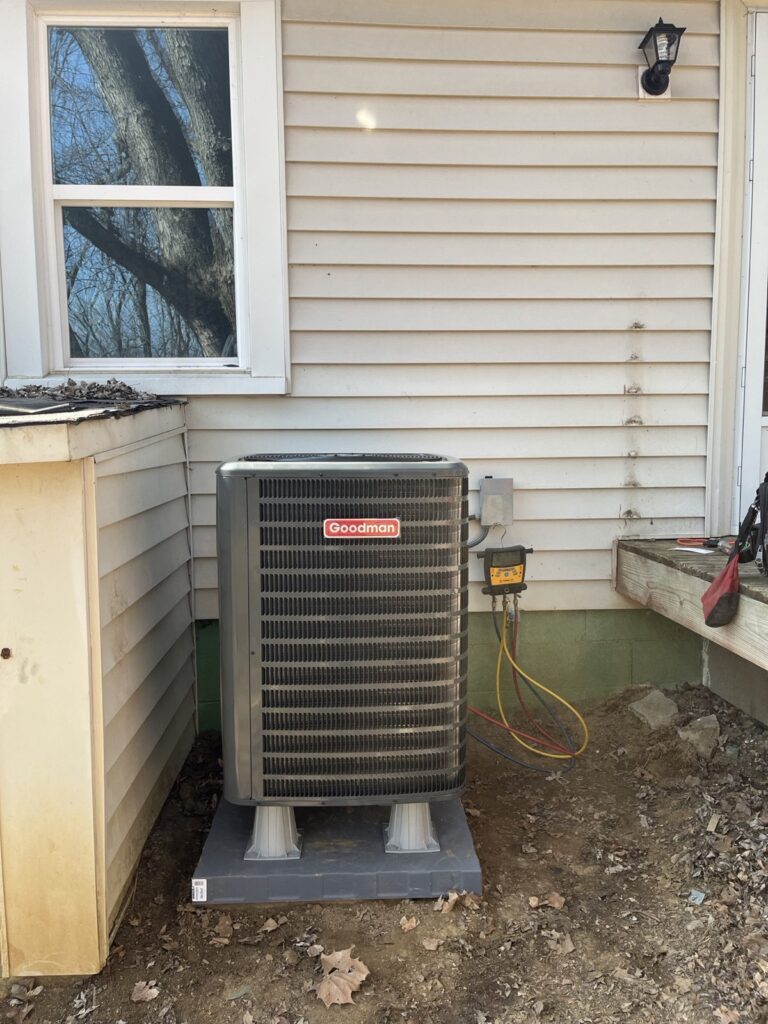
If you’ve done the fixes above and the bill is still climbing year over year, look at the furnace’s age. Units from the 1990s and early 2000s commonly run at 60–80% AFUE, which means 20–40 cents of every dollar of gas goes up the flue. Today’s high-efficiency Goodman and Amana furnaces reach 95% AFUE or better, and a properly sized system with a modern thermostat is where the biggest, most permanent savings come from. Our guide to furnace repair or replace walks through the decision, and the best HVAC systems for Louisville’s winter weather compares the options. Furnace 15 years or older? Our fall special includes a free written replacement estimate during the clean and check.
A quick heating-bill checklist
- Thermostat at 68°F with overnight and away setbacks
- Fresh furnace filter, checked monthly
- Ducts sealed and insulated where they run through unconditioned space
- Furnace cleaned and tuned this season
- Doors, windows, outlets, and the attic hatch weatherstripped
- Attic insulation at the recommended depth
- Indoor humidity 35–45%
- Vents open, returns clear, ceiling fans reversed
- Furnace age and efficiency rating known — and a replacement estimate in hand if it’s 15+
High heating bill FAQs
Why is my heating bill high when I’m barely home?
Usually one of three things: the thermostat holds a high temperature all day, the ducts leak heated air into the attic or crawl space, or the furnace is old and inefficient. A setback schedule and a duct inspection are the fastest ways to find out which.
Does turning the heat down at night really save money?
Yes. The myth that a furnace “works harder to catch up” has been tested many times and doesn’t hold; the longer the house sits at a lower temperature, the less heat it loses, and the savings are real.
Is a heat pump cheaper to run than a gas furnace in Louisville?
Often, especially in our mild shoulder seasons, though it depends on gas and electric rates and on how the system is set up. Heat pump vs. furnace for Louisville homes covers the trade-offs.
How much can a furnace tune-up lower my bill?
It depends on how dirty and out-of-adjustment the furnace was, but restoring airflow, cleaning the burners, and correcting the gas pressure routinely bring a neglected furnace back to its rated efficiency — and the safety inspection is worth the visit on its own. Details are in is an HVAC maintenance plan worth it?
Want the fast version? Book the $150 Fall Heating Clean & Check and we’ll handle the tune-up, test the airflow, check the ducts we can see, and tell you honestly whether the furnace is the problem. Serving Louisville, Highview, Jeffersontown, St. Matthews, and the surrounding neighborhoods since 1975.