A healthy furnace runs in long, lazy cycles: it lights, heats the house for ten or fifteen minutes, shuts off, and rests for a while before the thermostat calls again. A furnace that’s short cycling does the opposite — it fires up, runs for a minute or two (sometimes only seconds), shuts down, and starts again a few minutes later, over and over. It’s one of the most common complaints we hear on Louisville service calls once the weather turns, and it matters more than it seems: every start wears the igniter, the blower and the heat exchanger, the gas bill climbs, and the house never quite gets comfortable. Here are the nine causes we actually find, from the one you can fix tonight to the one that only a correctly sized replacement solves.
First: is it really short cycling?
Normal furnaces run three to six cycles an hour in cold weather, each lasting roughly 10–15 minutes. On a mild Louisville afternoon in the 50s, short, infrequent cycles are normal — the house just doesn’t need much heat. Short cycling is when the furnace runs for less than about five minutes at a time, turns on and off more than eight or so times an hour, or starts and stops every couple of minutes regardless of how cold it is outside. Count cycles for an hour on a cold evening. While you’re at it, look through the small sight glass on the lower furnace door: most furnaces made after the mid-1990s flash a diagnostic LED code when something trips, and the legend is printed on the inside of the panel.
The 9 causes of furnace short cycling, easiest first
1. A clogged air filter (the cause in roughly half the calls)
A dirty filter chokes airflow across the heat exchanger. With too little air moving, the furnace overheats internally within a minute or two, the high-limit switch trips to protect the heat exchanger, the burners shut off while the blower keeps running to cool things down, and then the whole sequence repeats. Replace the filter, give the furnace half an hour to cool, and watch it. If it settles into long cycles, you’ve found it — and you’ve also learned how quickly that furnace overheats, which is why our fall tune-up checklist starts with airflow.
2. Closed or blocked vents
Same physics, different restriction. Supply registers closed in unused rooms, a return grille blocked by a couch, or a filter installed backward all cut airflow enough to trip the limit. Open every register (closing them doesn’t save money — it unbalances the system) and make sure returns can breathe. Our guide to uneven heating covers the duct side of this in detail.
3. A thermostat problem
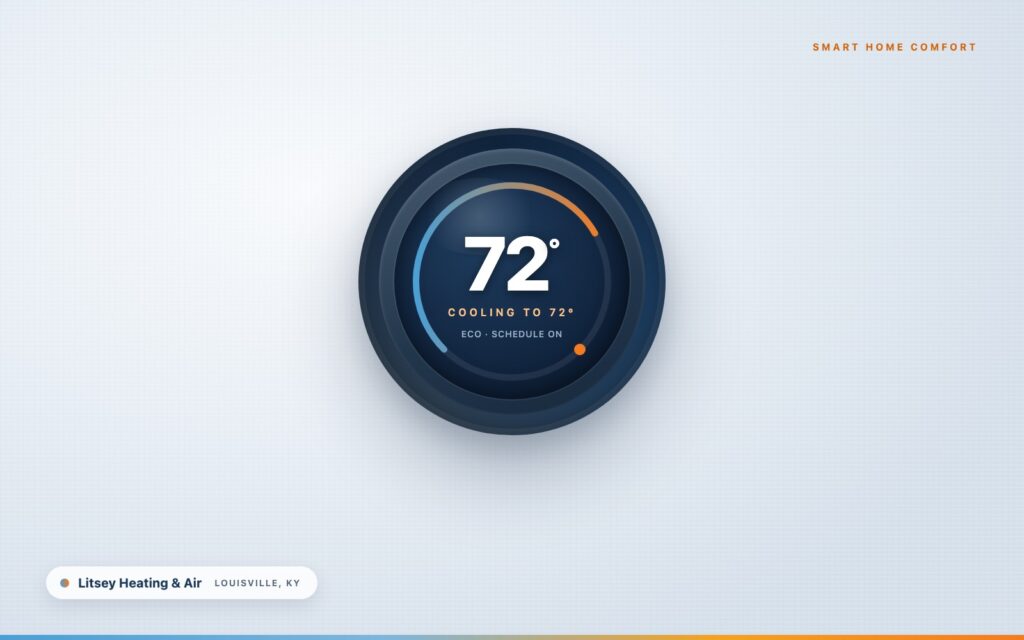
If the thermostat sits near a supply register, in direct sun, above a lamp or on a wall that backs onto the garage, it reads warm or cold too early and calls the furnace on and off in short bursts. Dead batteries and a loose wire do the same thing intermittently. Many thermostats also have a “cycle rate” or “swing” setting; one set too tight will chase the temperature half a degree at a time. If the furnace short cycles only when the thermostat is in certain modes, or the display drops out, start here. A properly placed smart thermostat fixes this permanently.
4. A dirty flame sensor (the classic “lights, then quits”)
This is the pattern homeowners describe most: the furnace lights, runs for five to ten seconds, shuts off, tries again, and after three attempts locks out for an hour. The flame sensor is a thin metal rod that proves to the control board that the burners lit. When it’s coated with oxidation, the board doesn’t see the flame and kills the gas as a safety measure. Cleaning the sensor is a five-minute job for a technician and part of every tune-up we do. If you’re mechanically comfortable, our 8 quick furnace checks explain what it looks like; if not, this is a routine, inexpensive repair call.
5. A failing high-limit switch or a tripped rollout switch
If airflow is fine and the furnace still cuts out on high temperature, the limit switch itself may be failing and opening too early. A different and more serious switch — the flame rollout switch — trips when flames escape the burner compartment, which points to a blocked heat exchanger or venting problem. A rollout switch usually has to be reset manually; if yours has tripped, don’t keep resetting it. Turn the furnace off and have the heat exchanger inspected. Our furnace safety and carbon monoxide guide explains why.
6. A blocked flue, intake or exhaust pipe
High-efficiency (90%+) furnaces breathe through two PVC pipes that end outside the house. Leaves in October, a bird’s nest, frost or drifted snow, or a dryer vent discharging nearby can partially block them. The furnace’s pressure switch senses the restriction and shuts the burners off mid-cycle, then tries again when it clears — a short cycle that comes and goes with the wind. Walk outside and look at the pipe ends. Older 80% furnaces vent through a metal flue; a damaged or sagging flue causes the same shutdowns.
7. A clogged condensate drain
Those same 90%+ furnaces produce water, which drains through a trap and a small line. When algae or debris clog it, water backs up into the pressure switch tubing or trips a float switch, and the furnace shuts down until it drains. The giveaways are gurgling, dripping or a puddle under the furnace. Clearing the line is simple; it’s also on our tune-up list for exactly this reason.
8. A weak blower motor or capacitor
If the blower is turning slowly because its run capacitor is failing or the motor bearings are tired, the furnace overheats the same way it would with a dirty filter — the air just isn’t being moved away from the heat exchanger. A humming blower that’s slow to start, or hot air that feels weak at the vents, points here. Capacitors are a cheap part to replace; letting them fail takes the motor with them. Our furnace noise guide covers the sounds that go with it.
9. An oversized furnace
This is the one no filter change fixes. A furnace with too much capacity for the house heats the thermostat’s room to the set point in a few minutes and shuts off before the rest of the house catches up — then does it again. It short cycles from the day it’s installed, wears out early, and leaves far rooms cold. It happens when a replacement is sized by “what was there before” or by square footage alone instead of a proper heat-loss calculation. If your furnace was replaced in the last few years and has short cycled ever since, this is the likely cause. The real fix is correct sizing at the next replacement, ideally with a two-stage or modulating furnace that can run low and long; see what installation costs in Louisville and how a proper install day goes.
What you can safely do tonight
- Replace the filter and open every supply and return register.
- Put fresh batteries in the thermostat and check that it’s set to Heat, fan on Auto, with nothing warm nearby.
- Go outside and check the intake/exhaust pipes (or the flue) for blockages.
- Look for the LED code through the sight glass and note the flash pattern.
- Turn the furnace off at the switch for 60 seconds and back on — once. Repeated resets of a furnace that keeps locking out only add wear.
- Never bypass, tape or jumper a limit, rollout or pressure switch. They’re what keep a fault from becoming a fire or a carbon monoxide leak.
When to stop and call
- The furnace locks out again after one reset.
- A rollout switch has tripped, there’s a burning smell, scorching near the burners, or a CO alarm has sounded — turn it off and read our CO safety guide.
- The blower isn’t running at all, or runs nonstop cold.
- The furnace is 15+ years old and short cycling is new — the limit may be tripping because the heat exchanger is restricted.
- You’ve done the list above and it’s still cycling. At that point it’s a flame sensor, switch, motor or sizing problem, and guessing at parts costs more than a diagnosis.
What the repair usually involves
On a service call we measure the temperature rise across the heat exchanger and the static pressure in the ductwork, read the stored fault codes, and test the flame sensor, limit and pressure switches, capacitor and blower. Most short-cycling repairs are one of: cleaning or replacing the flame sensor, replacing a limit or pressure switch, clearing the condensate drain, replacing a capacitor or blower motor, or relocating or replacing the thermostat. You get a written quote before anything is replaced, and Annual Service Plan members get 10% off parts. If the cause is sizing or a failing heat exchanger on an older furnace, we’ll walk you through the repair-or-replace math rather than keep patching it.
Why short cycling costs you money before it breaks anything
Every furnace start is the least efficient moment of the cycle: the igniter draws power, the burners run before the heat exchanger is up to temperature, and the blower moves lukewarm air. A furnace starting twenty times an hour instead of four is burning gas to warm itself up instead of your house, which is one of the hidden reasons behind a heating bill that jumped. It also means the igniter, blower motor and heat exchanger see years of wear in a single winter. Most of the causes above are caught — and prevented — by a fall clean and check, which is exactly what the Fall Heating Clean & Check Special covers for $150 per system for the year, spring AC visit included.
Furnace short cycling FAQs
My furnace is short cycling with a brand-new filter. What else is it?
If the filter is new and installed the right way round (arrow pointing toward the furnace), move to airflow at the registers, then the flame sensor pattern (lights for seconds, then quits), then the outdoor pipes and condensate drain. A new filter that’s much more restrictive than the old one — a very high-MERV 1-inch filter, for example — can itself cause overheating; try a standard pleated filter.
Why is my furnace short cycling and blowing cold air?
That’s the high-limit pattern: the burners shut off on overheating but the blower keeps running to cool the heat exchanger, so you feel cool air for a minute or two. Filter and airflow first; if that doesn’t solve it, the limit switch, blower or capacitor is next.
Why does it only short cycle at night?
Colder nights mean longer calls for heat, which is when an airflow or overheating problem shows up. A thermostat that reads a nearby lamp or TV during the evening, or a deep night setback that makes the furnace run hard to recover, can also do it.
Is furnace short cycling dangerous?
Usually it’s a comfort and cost problem, but two causes are safety issues: a tripped rollout switch and a restricted or cracked heat exchanger. If a reset button has popped, there’s a burning smell, or a CO detector has gone off, shut the furnace down and call. If you don’t have a CO detector on each floor, get one this week.
Will a tune-up fix short cycling?
Often, yes — cleaning the flame sensor and burners, clearing the drain, testing the switches and capacitor, and checking airflow are all part of our clean and check, and together they cover the majority of causes. A tune-up won’t fix a thermostat in the wrong spot or an oversized furnace, but it will identify them.
How much does it cost to fix a short-cycling furnace?
It depends entirely on the cause: a filter costs a few dollars, a flame sensor cleaning or capacitor is at the low end of a repair call, a blower motor is more, and sizing is a replacement conversation. We diagnose first and quote in writing before any part is replaced.
Furnace turning on and off every few minutes? Tell us the pattern when you call and we’ll tell you whether to shut it down tonight. Serving Louisville, Highview, Jeffersontown, St. Matthews and the surrounding neighborhoods since 1975 — veteran-owned, licensed (License # HM05930).
Request a Callback 📞 (502) 415-5214
Request a callback from our office
Tell us what's going on and our office will call you back during business hours, Mon–Fri 8AM–6PM. No heat or no cooling right now? Call (502) 415-5214 — the emergency line is answered 24/7.
- Licensed & insured — KY License # HM05930
- 2-hour arrival windows, quote before any work begins
- Veteran-owned, serving Louisville since 1975